Lo Contador
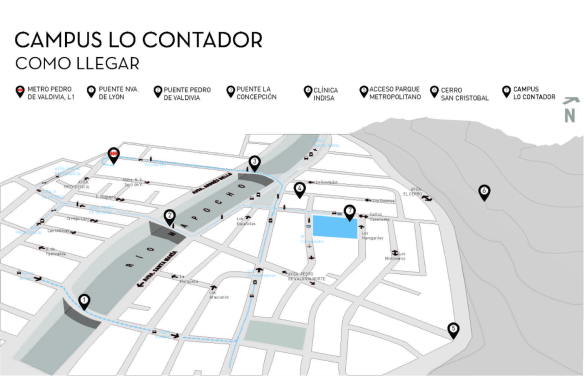
Location
Campus Administration
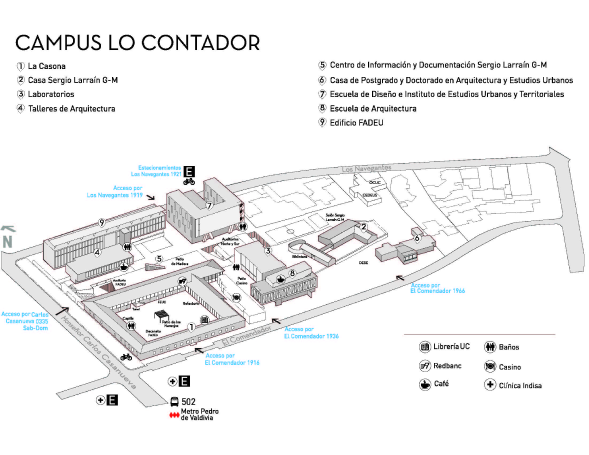
Address: El Comendador 1916, Providencia
Schedules
- El Comendador 1916 Gate: Monday to Friday (except holidays) open from 7:00 AM to 10:00 PM
- Los Navegantes 1919 Gate (including parking access): Monday to Friday (except holidays) open from 7:00 AM to 10:00 PM
- Carlos Casanueva 0335 Gate: Monday to Friday, open from 7:00 AM to 10:00 PM. Saturdays, Sundays, holidays, and vacation periods (February), open 24 hours
Campus Map
History
Text by Fernando Pérez Oyarzún.
In the Pedro de Valdivia Norte neighborhood, between San Cristóbal Hill and the Mapocho River, the presence of a site that has remained almost unchanged over the last century is striking. Even more surprising is the fact that this place houses the Faculty of Architecture, Design, and Urban Studies of the Universidad Católica, where some of the country’s most prominent architects were trained, and that its old walls are interwoven with contemporary constructions that are both radical and respectful.
When I first crossed the entrance hall of the Lo Contador house, I was struck by how, in the middle of the city, a landscape survived that so powerfully and qualitatively evoked the rural world and colonial culture.
More than forty years walking through its corridors have not managed to erase the strength of that first impression, the same one that anyone who ventures up the steps of El Comendador Street and enters through that hallway will experience today.
The preservation of a site like this is largely due to Sergio Larraín, who convinced the Universidad Católica to establish the Faculty of Architecture there, of which he was dean. This occurred in 1959, and since then, the University has cared for this site, now a national monument. It was he who purchased an administrative residence for himself and the land located in the eastern half of the block, where he built homes for his children.
The history of the house dates back to the 18th century, when Francisco Antonio Avaria purchased a series of small properties between San Cristóbal Hill and the Mapocho River for his orphaned niece, Mercedes Contador, thus establishing the Lo Contador farm. There he built a house that would form part of her marriage dowry. During the 19th century, Mercedes expanded the property to allow for spiritual exercises: around the current Patio de los Naranjos (Orange Tree Courtyard), she built a chapel, a refectory, and rooms for those practicing the exercises.
The site was adapted to its new university functions. Pavilions designed by Horacio Borgheresi expanded the available space, which were gradually replaced by new constructions.
In 1996, the new underground library designed by Teodoro Fernández, Smiljan Radic, and Cecilia Puga was inaugurated, contrasting with the house while simultaneously adapting to it. A wooden deck on its roof, with the permanent presence of the Andes Mountains and San Cristóbal Hill, constitutes the most common meeting place for students.
The purchase of Sergio Larraín’s home, along with several belonging to his daughters, allowed the campus to expand eastward, generating a succession of spaces that, like a labyrinth, provide a variety of garden corners that interconnect the various campus buildings.
The original richness of the house has been complemented by the contributions of various architects who have built the campus landscape around it. Notable among these are the cafeteria by José Cruz; the architecture classrooms and workshops by Renato Parada and Alfredo Jüneman, later remodeled by Alejandro Aravena; the former School of Art by Juan José Ugarte, Pilar García, and Wren Strabucchi; the Postgraduate Center by Sandra Iturriaga and Wren Strabucchi; and the new Design and Urban Studies building by Sebastián Irarrázaval.
Walking through the campus spaces, as students, professors, and staff do daily, and visitors and neighbors do occasionally, allows one to enjoy an unusual historical and architectural density where past and present go hand in hand.
Text source: “Lo Contador: una casa, un campus”
More information here (Lo Contador: Casa, Barrio, Ciudad. Text by Fernando Pérez in ARQ n°65)
More information about Lo Contador Campus plans and projects here (Prepared by: DESE UC)
Image Source
01 Aerial photograph circa 1943. Military Geographic Institute
02 Aerial photograph circa 1954. Military Geographic Institute
03 Aerial photograph circa 1961. Military Geographic Institute
04 Photograph of the Lo Contador house. c.1900. Author unknown. Photographic Archive of the National Historical Museum, Santiago, Chile
05 Photograph circa 1940 of the north facade of the farmhouse. Author unknown. In Amenabar, Larach, Guerrero “Lo Contador: Un Nuevo Destino.” Thesis (Arch) PUC. Santiago, Chile, 1975
06 Photograph circa 1940 of the north corridor of the farmhouse. Author same as above